The Spirit of the Safari: Engineering for the Big Five
Big Bore
Hunting the "Big Five"—Elephant, Lion, Leopard, Cape Buffalo, and Rhino—is the most violent environment a rifle can enter. Between the abrasive "moon dust" of the Kalahari, the 110°F heat of the Zambezi Valley, and the adrenaline-fueled chaos of a charging animal, the margin for mechanical error is zero.
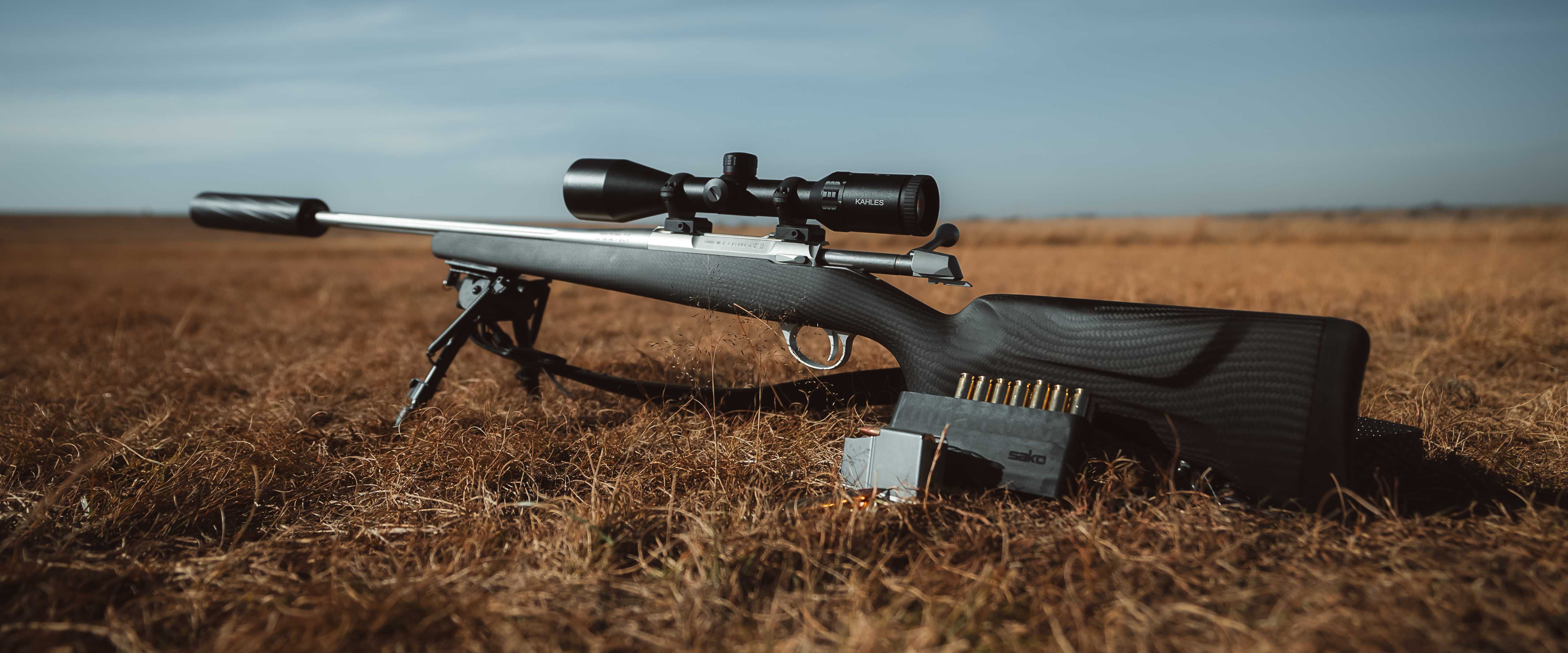
When you carry a Sako into the "jess," you aren't carrying a hobbyist's tool; you are carrying a professional-grade weapon system. For the modern safari, the conversation centers on the Sako 90 and the Sako 100. These platforms represent a departure from the "semi-controlled" feeding of the past, moving toward a robust, high-speed push-feed system optimized for the fastest possible follow-up shots and failsafe ejection.
The Sako 90: Re-Engineering the Push-Feed for Survival
There is a persistent myth that only "controlled round feed" can survive Africa. The Sako 90 challenges this by utilizing a ultra-refined push-feed action that prioritizes speed, strength, and redundant ejection. In a dangerous game scenario, the ability to cycle the action under stress without "binding" is your primary defense.
1. The Dual-Plunger Evolution
The most critical upgrade in the Sako 90 is the dual-plunger ejection system, a design borrowed from the world-renowned TRG sniper platform.
- The Problem: In high-heat environments, brass cases expand. A single plunger ejector can sometimes struggle to clear a "sticky" magnum casing, leading to a stovepipe jam.
- The Sako Solution: By using two plungers, the Sako 90 provides twice the ejection force and—more importantly—a more consistent ejection angle. Regardless of how fast you "rip" the bolt back, the empty brass is violently cleared from the port. This ensures that the ejection path is clear for the next .375 H&H to be stripped from the magazine instantly.
2. The Broached Receiver: Smoothness Under Pressure
A bolt-action is only as fast as its friction coefficient. Sako 90 receivers are broached, not just drilled.
- The Logic: Sako uses multiple bolt-shaped cutting tools to carve the internal surfaces of the receiver. This minimizes the contact area between the bolt and the receiver rails.
- The Safari Benefit: When you are covered in the fine, abrasive dust of the African bush, a "tight" action will seize. The Sako 90’s design allows for high-speed operation even when the action is dry and dusty. It’s the "Sako Slide"—a bolt throw so smooth you can keep your eye in the glass while cycling, ensuring you never lose sight of a wounded animal.
The Sako 100: The Apex of Safari Engineering
The Sako 100 isn't just a rifle; it is a modular survival system for the global explorer. While the Sako 90 is a masterclass in the traditional bolt-action, the Sako 100 introduces safety and versatility features that change the "rules" of the safari.
1. The Manual Cocking System (Handspannung)
In a dangerous game encounter, you are often moving with a round in the chamber. In a traditional rifle, the firing pin spring is under tension, held back only by the sear.
- Condition Zero Safety: The Sako 100 allows you to carry the rifle with the firing pin spring completely relaxed. There is no stored energy in the system. Even if you fall in a donga or the rifle is dropped from a Land Cruiser, it is physically impossible for the rifle to fire.
- The Silent Prep: When the Professional Hunter (PH) whispers "take him," you push the cocking lever forward on the bolt shroud. It is a silent, ergonomic motion. This allows you to hunt in "Condition Zero" safety until the very second the crosshairs settle on the shoulder.
2. Switch-Caliber Versatility
A typical safari involves "Plains Game" (Oryx, Kudu, Zebra) followed by "Dangerous Game" (Buffalo or Lion). Usually, this requires two rifles. The Sako 100 solves this through its switch-barrel platform.
- Barrel-Mounted Optics: On the Sako 100, the scope mount is attached directly to the barrel, not the receiver. When you swap from a .300 Win Mag barrel to a .375 H&H barrel, the zero stays with the barrel.
- The 7Nm Torque Standard: Sako provides a calibrated torque wrench for the barrel change. This ensures that the headspace and alignment remain identical every time. You can fly to Africa with one stock and two barrels, knowing your 400-yard plains game zero and your 50-yard "stop-a-charge" zero are both perfectly preserved.
Redundant Reliability: The Sako "Over-Engineering"
Both the 90 and 100 share DNA that is specifically suited for the African environment.
1. The Total Control Magazine Latch (TCL)
In the American West, losing a magazine is an inconvenience. In the "jess," it’s a catastrophe. Many high-end rifles have a simple "push-button" magazine release. In thick brush, a thorn branch can easily depress that button.
- The Fail-Safe: Sako’s TCL requires the shooter to push the magazine upward while simultaneously pulling the release latch back. It is a conscious, two-step process. You cannot "accidentally" dump a Sako magazine.
- All-Steel Construction: Plastic magazine feed lips can warp in the 110-degree heat, causing "pop-outs" where rounds fly out prematurely. Sako uses heavy-gauge steel magazines, ensuring the feed geometry remains identical regardless of the ambient temperature.
2. Three-Lug Strength and 60-Degree Lift
Both the 90 and 100 utilize a three-lug bolt design.
- Locking Strength: Three lugs provide a massive amount of surface area for locking, allowing the rifle to safely handle the high pressures of safari magnums like the .416 Rigby or .375 H&H.
- Optic Clearance: The 60-degree bolt lift provides maximum clearance for large tactical turrets or heavy-duty safari optics. It prevents you from "barking" your knuckles on the scope when you need a fast follow-up shot on a breaking buffalo.
Terminal Ballistics: The Powerhead and the Blade
A safari rifle is only as good as the projectile it launches. For the "Big Five," the bullet must perform two contradictory tasks: it must expand to create a massive wound channel, yet it must retain its weight to punch through heavy bone.
1. The Powerhead (Barnes TSX)
Sako has long partnered with Barnes to load the Powerhead series. For dangerous game, the "Triple-Shock" (TSX) is the gold standard.
- Deep Penetration: Being a monolithic copper bullet, it doesn't have a lead core to separate. When it hits a buffalo’s shoulder, it peels back into four sharp petals, creating "hydrostatic shock" while retaining 100% of its weight for deep, linear penetration.
2. The Sako Blade
For thin-skinned but dangerous cats—Lion and Leopard—you need immediate energy transfer. The Sako Blade ammunition utilizes a multi-staged expansion tip. It is engineered to expand at both high and low velocities, ensuring that all its kinetic energy is dumped inside the chest cavity to "anchor" the animal on the spot.
The Ethics of the Professional
At the end of the day, the "Spirit of the Safari" is about respect for the animal. An ethical kill is the result of a rifle that stays out of the hunter's way. You don't want to be thinking about your safety, your magazine latch, or your bolt's extraction cycle when a buffalo is at 40 yards.
The Sako 90 and 100 are built for the hunter who understands that in Africa, you don't get a "do-over." The metallurgy must be perfect, the ejection must be redundant, and the safety must be absolute. Whether you prefer the refined traditionalism of the Sako 90 or the modular future of the Sako 100, you are carrying a century of Finnish engineering designed to bring you home safely from the most dangerous places on earth.
Bring a Sako. Because in the long grass, "good enough" is a dangerous gamble.