The Ethics of the Long Shot: Where Ballistics Meet Morality
Long-range Shooting
There is a seduction in the long shot. We see it on social media and in high-gloss hunting films, a hunter perched on a rimrock, dialing a turret, and dropping a bull elk at a distance measured in half-miles. But what the camera rarely captures is the "probability of error."
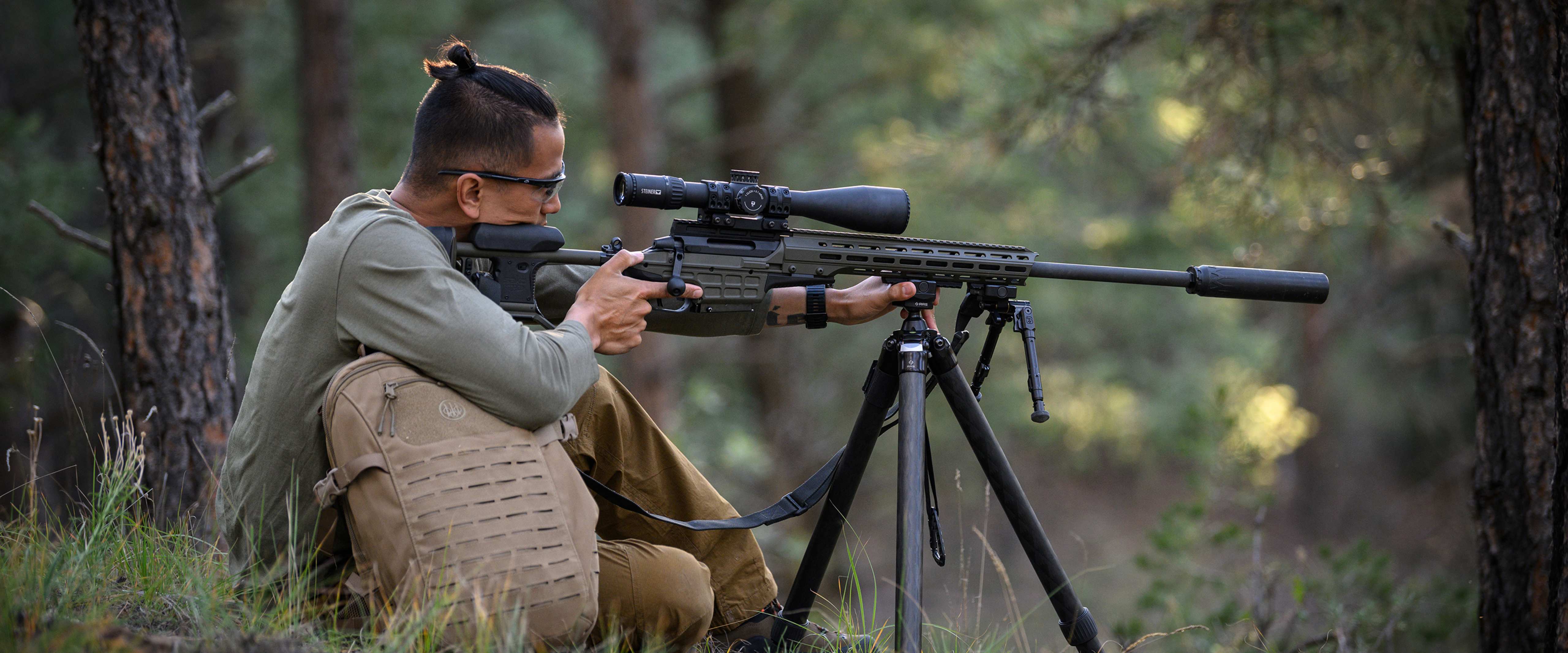
As a Sako shooter, you are carrying one of the most accurate production rifles on the planet. Whether it’s a Sako 90 or a TRG, the rifle is mechanically capable of sub-MOA precision. However, in the field, "accuracy" is only one part of the equation. Ethical hunting is not about what the rifle can do; it is about what the hunter should do to ensure a clean, instant kill.
The Flight Time Trap: The Variable You Can’t Control
Most hunters focus on "drop" and "drift," but the most dangerous variable at long range is Time.
At 600 yards, a standard magnum projectile (like a .300 Win Mag) has a flight time of approximately 0.75 to 0.85 seconds. This may seem instantaneous, but in the biological world, it is an eternity. An elk can take a single step in 0.4 seconds. A deer can "load" its legs to jump a fence in 0.3 seconds.
If you break a perfect shot at an animal standing broadside at 600 yards, and that animal decides to take a step toward a patch of browse while your bullet is in mid-air, you have just moved your point of impact from the lungs to the gut. No amount of "custom tuning" or "match-grade" consistency can account for the autonomous movement of a living creature. The ethical hunter recognizes that the longer the bullet is in the air, the higher the "Biological Risk."
The Terminal Velocity Floor
Precision is useless without terminal performance. For a bullet to do its job—to expand, create a permanent wound channel, and dump its kinetic energy—it must impact at a specific velocity.
- Expansion Thresholds: Most premium hunting bullets (even the sophisticated Sako Blade) require a minimum impact velocity to "mushroom" correctly. This is usually around 1,800 to 2,000 feet per second (fps).
- The Needle Effect: When a high-BC bullet impacts below its expansion threshold, it acts like a needle. It passes through the animal, zipping through soft tissue without expanding. The result is an animal that runs for miles and is often never recovered.
Before you dial your Sako for a 500+ yard shot, you must know your "Velocity Floor." If your ballistic app shows that your projectile has dropped below 1,800 fps at the target's distance, you have no business pulling the trigger.
The "Windage" Gamble
Elevation is a math problem; Wind is a guessing game. Even with a high-end Kestrel and a Sako TRG, "reading the wind" is an imperfect science.
The wind at your muzzle is rarely the wind at the target, and it is almost certainly not the wind in the canyon in between. A 5-mph error in your wind call at 200 yards is a miss of a couple of inches. At 700 yards, that same 5-mph error can result in a 20-inch miss. In a high-country environment where the wind "swirls" and "bubbles" over ridgelines, the probability of a clean hit drops exponentially with every 100 yards added to the range.
The "Stamina of the Stalk"
We often hear the phrase "I couldn't get any closer." In 90% of those cases, what is actually meant is "I didn't have the stamina to get closer."
The "Sako Mindset" is built on the heritage of the Finnish marksman—patience, resilience, and a deep respect for the quarry. Using a high-precision rifle as a "crutch" to avoid a difficult stalk is a violation of the hunter's code. If you have the time and the terrain to close the gap from 600 yards to 300 yards, you have a moral obligation to do so.
Closing the distance doesn't just make the shot easier; it exponentially increases the bullet's energy, decreases the flight time, and reduces the effect of the wind.
The Responsibility of the Correction
A long-range shot carries a "heavy" follow-up requirement. If you fire at 700 yards and the animal doesn't go down, your responsibility to "finish the job" is immediate.
- Terrain Barriers: If there is a canyon, a river, or a cliff between you and the animal that will take you two hours to cross, a long-range shot is inherently unethical.
- Observation: You must be able to stay in the glass to watch the impact and the animal’s reaction. If the recoil of your magnum rifle "jumps" you off the target and you can't see the hit, you are shooting blind. This is why the muzzle brakes and recoil management on the Sako 90 and 100 are so critical—they aren't just for comfort; they are for the visual accountability of the shot.
The Final Calculation
Respecting the quarry means acknowledging that the animal deserves a "perfect death." It is not a target in a PRS match; it is a living being.
When you lie prone and look through your glass at a trophy animal, ask yourself: Am I taking this shot because I’m a great shooter, or am I taking it because I’m too tired to be a great hunter?
Our rifles were built to give you the capability to make the hard shots, but it was your heritage as a hunter that gave you the wisdom to know when to hold your shot. If you can’t guarantee a 100% ethical outcome, the real "Long Range Master" is the one who chooses to crawl another hundred yards.